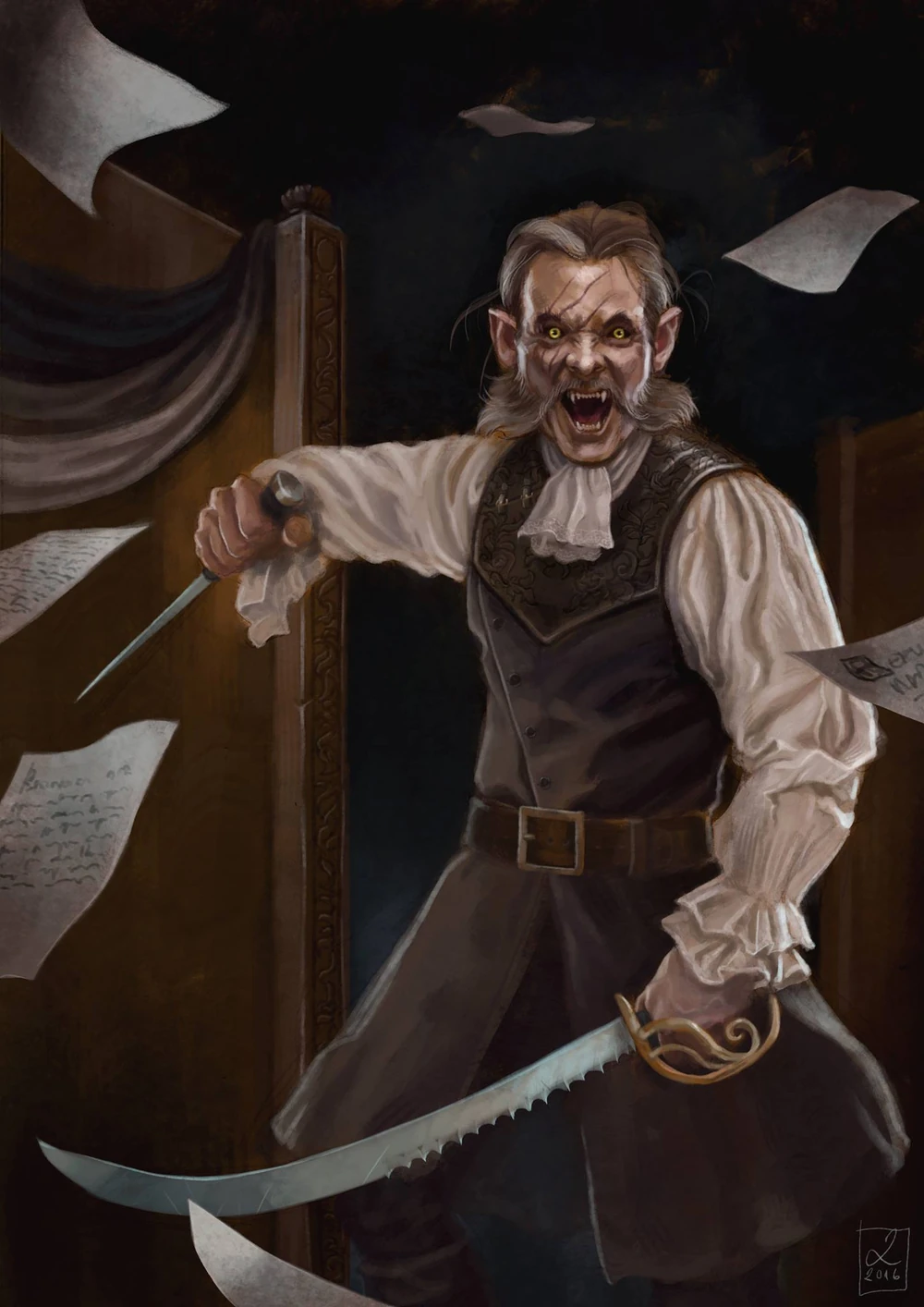

“So it may be said that both parties have been satisfied: the Vampires and the Werewolves, and those who fear them.”
With these words the Archqueen Karolina-Louise explained her new Legislation concerning Vampires and Werewolves before the astonished Archroyal Assembly. By it, the decrees of the Archking the Restorer were overturned.
The enlightened circles, the journals of Practical Popular Education, the librarian Greb, and the composer Zerlich—all of them praised the measure to the heavens. They called it the “Light of Reason” and bestowed upon Karolina-Louise, in their enthusiasm, the most radiant of titles: “Enlightener” and “Broad-Minded.”
Within this social circle, if we except a few eccentric seekers after novelty, such as are found in every society, the enthusiasm for the return of Vampires and Werewolves ends. Beyond it, among the great masses of a people not yet touched by enlightenment, another sentiment prevailed. It was not political opposition to the Legislation.
It was the simplest, the purest of all sentiments: fear.
The abstract doctrine that all Humans, Werewolves, and Vampires are born equal; that all are endowed with Reason; and that they ought therefore to enjoy equal opportunities, may sound beautiful enough. But the prospect of welcoming into one's midst creatures eternally thirsty for human blood was another matter. With every bite, such creatures might transform one's own neighbour into one of their kind. Then there were those who, at every full moon, became wolves and were said to delight above all in human flesh. And, beyond this, there stood the ancient tale that Vampires and Werewolves were united in conspiracy to destroy all human rulers, take their places, and plunge the world into perpetual bloodshed.
Ideas which had sounded so fair in the halls of philosophy therefore appeared considerably less attractive when brought face to face with such fears.
In vain did the journals of Practical Popular Education print, between their fables from every corner of the world and their recipes for wine, soft drinks, and medicines, articles explaining that many of the common beliefs concerning Vampires and Werewolves had never been established as facts.
The influence of reason was weaker in many a village than the influence of years and years of fearful tales. People had long been told that Vampires and Werewolves possessed secret arts by which they concealed their wicked nature, presenting themselves as innocent victims of superstition and cunningly awakening compassion in the good and unsuspecting hearts of Humans.
By an additional Act, Karolina-Louise had postponed the admission of these new inhabitants until the first quarters prepared for them should be ready for occupation. Yet the fear was already so great that one might have imagined a Werewolf and a Vampire lurking in the cellar and attic of every house.
The reports carried by the Gazette of the Star Fortress and other pro-Government newspapers were intended to awaken a very different sentiment. They spoke of the Vampires of Neuland and the Archipelagos, who, singing Archroyalist songs in their exile, were preparing their belongings for the return to their native land. They spoke of how they had “not forgotten, even in exile, their Sigislandic candles and the portraits of their ancestors.” They recalled the childhood they had spent there and the beauties of their homeland which, they said, no other country had ever been able to replace in their hearts.
Yet instead of producing the fraternal solidarity which the Government desired from Sigislanders towards their exiled countrymen of different physical nature, these reports produced, in many places, precisely the opposite effect. They increased the panic at the approaching return of the “creatures.”
Prenlein's Count Velstein was printed and sold more widely than ever. So too were all manner of superstitious objects and ancient books of sorcery.
The heart and spirit of the ordinary Sigislander was now deeply troubled. Loyalty to the reigning Archqueen demanded a full and devoted obedience to all Archqueenly Legislations. Yet the inward fear of the “monsters” made that very Legislation almost unbearable.
Many now began to ask the question: Does this mean, then, that the Archking the Restorer was wrong to banish the Vampires?
The Gazette of the Star Fortress appeared almost every day with fresh explanations intended to persuade its readers that, in the time of Ferdinand, there had indeed been reasons for banishing the Vampires; but that those reasons had since been removed, and that the Vampires could therefore safely be restored.
Nevertheless, the greater part of the people remained unconvinced. They looked upon the restoration of what they had already begun to call the “monster quarters” with dread, and counted down the days with trembling hearts until Sigisland should once again have humanoid inhabitants with fangs.
To all this there must finally be added the case of the celebrated Vampirologist Doctor Zacharias Steiner, who had served Ferdinand II at the Archroyal Academy.
For a time, Karolina-Louise had wished to consult him concerning her Legislation on Vampires and Werewolves. She abandoned the idea, however, after hearing rumours concerning certain of his researches in Vampirology. The rumours so troubled her that she declared that a “conversation with such a person would be too exhausting, and that she had no strength for it,” adding that she was “not certain that she wished to know everything that had been done in the name of the Crown of Torches.”
Steiner, for his part, could not restrain himself from criticising the new Legislation. Nor could he refrain from issuing threats against the returning Vampires.
His friend, the Baron of Austenberg, therefore persuaded him to undertake a certain commission in the turbulent region of the Tenelon Sands. It was a prudent expedient. There, far from Kelenburg, Steiner might be spared the punishment which would almost certainly have overtaken him had he continued to defy the Archroyal Legislation in the capital.
The Legislation concerning Vampires and Werewolves could not, however, entirely drive from the public mind the other events which, in this turbulent period, were shaking the Archkingdom of Sigisland.
The Audience at Erzkoenighaus on the first of June, to which the most distinguished nobles were summoned—the fathers of those young men who had joined the unlawful and recklessly daring “Purple Legion”—was the Archqueen's urgent attempt to bring an end to an affair without precedent in the history of the Archkingdom.
In the Hettin Salon of Erzkoenighaus, the New Archkingdom and the Old now stood face to face.
The New was embodied in a single person seated upon a gilded armchair before the tapestry of Francis's Fleet. And, in truth, it was so: Reber and the other Ministers were but bureaucratic executors of her will. There sat Karolina-Louise in a white gown, with the purple Archroyal sash and crinoline.
The Old Archkingdom was embodied in the Counts, who glittered in gold-embroidered, Second-Ferdinandian coats with their skirts thrown open.
Both sides feared the other.
Karolina-Louise knew that the parents of the disobedient “Purple Legionaries” were among the wealthiest, most influential, and oldest Counts in the country. She knew how deeply she had offended these men by abolishing their estate privileges, imposing heavy taxes upon their favourite amusement—hunting—even upon their private estates, restoring the Vampires to the country, and refusing military assistance to the King of Guntreland.
She also knew that, if she spared their underage sons the punishment prescribed by her Legislation, she might win from many of these dissatisfied nobles a gratitude of considerable value. This, therefore, was the moment to “appease” them, as she would later write to her Archchancellor.
But if, on the contrary, she declared the “Purple Legionaries” traitors, thereby condemning them to death, every possibility of winning this estate to her side would disappear.
Such a course might open the door to all manner of difficulties, perhaps even to conspiracies like that which, by sheer good fortune, had failed to cost the life of her distant predecessor, the Archking Eugene. There had also been the recent conspiracy in the South, whose escalation had been prevented only by the purple fidelity of Baron Sigismund.
The nobles, for their part, knew that they stood before a Sovereign who possessed the right “to create and destroy, and to bestow upon her Subjects life and death.” They knew also that she was exceedingly popular among the plebs. And, considering the nature of their ruler, they understood that a single ill-chosen word might cost them, or their children, their lives.
Karolina-Louise began the meeting with courtesy. Smiling, and with a musical voice, she greeted each of the assembled nobles, addressing every one of them with the full respect due to his title.
Yet immediately after this opening display of graciousness, her countenance changed.
She thrust her lower lip forward and drew her brows together. Then, with the sharp gaze of her clear blue eyes, she looked upon each of the nobles in turn. In that gaze there was anger, sorrow, and something like horrified curiosity.
These were the fathers of children who had rebelled against her commands. And even now she could not know with certainty the full part each man had played in the affair.
Under that piercing gaze, the Counts and other nobles became exceedingly humble. They apologised for the deeds of their sons and promised that their children would one day redeem their present “youthful imprudence” through faithful service to the Archkingdom and through great accomplishments enhancing its glory.
More than this, they begged her to employ all her influence with foreign rulers so that their sons might be brought back, “even by force,” from the battlefield upon which death seemed almost certain.
But Karolina-Louise was well informed. Minister Hefnes had performed his intelligence duties admirably.
She knew that many of these same men had not been so humble at the balls held in their palaces, where admission was granted only to the nobility “of the oldest blood,” the former First Estate. There, many had boasted of the “heroism” of their children.
Indeed, the very same Count Frederick von Delkenau-Savendorf, who now begged her to spare his son from mortal danger and from the shameful mark of a traitor, had, from a gilded sofa in his salon, before more than fifty guests, spoken these words:
“We raised our children to value the honour of the Crown of Torches above everything else. Yet it appears that the Archqueen who bears that Crown cares nothing for its honour.”
Karolina-Louise herself had spoken of the Purple Legionaries before the Diet immediately after learning of their undertaking. Her words then had breathed understanding and had seemed to promise amnesty:
“It is terrible to disobey commands, and no adult man could expect such conduct to be tolerated. Yet these are children—our Sigislandic children, mad with courage, who went of their own accord to another continent to defend the honour of Sigisland, in the manner which they wrongly believed such honour must be defended.
“And I, as their Sovereign, feel bound to honour their courage. However inadmissible their conduct may have been, I have faith in my young Subjects. They will grow older, they will become serious, and they will correct their errors.
“They are the flower of our youth. We want them home. We want to make their Archroyalist zeal useful to the Crown, and together with them, who are the future of this country, we shall overcome all the difficulties which stand in the way of our common success.”
Now, in conversation with their fathers, she employed harsher words:
“You do not wish your foolish children to perish, nor to be declared traitors, do you?
“They now have an opportunity to return home without consequences, and to channel their energy into something useful. I hope it is clear to you that the State is doing a gracious thing for your children, and that you will do everything in your power to ensure that they seize the opportunity now offered to them.
“They may not receive another.”
She further declared herself prepared to proclaim that all the young men of the Purple Legion had, “by their courage, proved themselves worthy of the military category,” and to open for them new places at the finest Archroyal Military Academy.
The cost of their elite military education, however, would still be borne by their “already exceedingly wealthy” parents—as “an educational measure, since they had failed to exercise proper control over their sons.”
She spoke at length, and with that characteristic enthusiasm which always possessed her when discussing proposals that, in her eyes, would bring good to her Archkingdom and improve the lives of its people. She described her plans for a new and greatly enlarged elite military academy, which was to bear her name and be known as the Karolinianum.
There would be room there for all the Purple Legionaries.
“But when I say elite school,” she explained, “I do not mean merely the highest quality of instruction, which is guaranteed. I mean dormitories, dining halls, and exercise halls which, in their luxury and equipment, shall not fall behind your own palaces. Thus shall the Archkingdom demonstrate that it cares for those of its children who desire to defend it with weapons in their hands.”
As she spoke, she assumed that characteristic gesture of hers: the hand slightly curved, the fingers spread upon her breast, the wrist turned away from herself.
“Beside the Karolinianum there shall be training grounds designed to resemble battlefields. And, though not in the first year, we shall build an entire fortified village for the practice of sieges and the capture of inhabited places.
“This school will be exceedingly expensive. I trust that this will not trouble you when the education of your heirs is concerned. Yet the State shall provide scholarships for the Karolinianum to the most talented entrants into the military category. Thus, to be born among the poorer classes shall not be an obstacle to receiving the opportunity of the most elite education.”
This Karolinianum was, in truth, a compromise forced by circumstances.
The majority of the nobles disliked the scholarships intensely. They had no desire to see the sons of farmers and herdsmen standing in the same ranks, or sleeping in the same dormitories, as their own heirs. Yet they remained meekly silent and betrayed no displeasure. They were conscious that the Archqueen might have dealt with them far more severely had she chosen to do so.
Karolina-Louise, for her part, knew in the depths of her heart that it was unjust for the greater part of the places in so exclusive a school to be reserved for those whose parents could afford to pay for them. But she also understood that she had few alternatives if she wished to preserve good relations with the high nobility and, at the same time, give the Purple Legionaries a powerful inducement to return to their homeland.
“I hope,” she said at last, looking sternly through her spectacles at each of the Counts in turn, with the very same expression she had worn when she first greeted them, “that I shall not even have to ask whether any of you assisted in the organisation and escape of the Purple Legion.
“For you know very well that such an act would constitute high treason. And you are not minors, whose youth might offer you an excuse before me.”
The Counts shook their heads. They swore by the candles of their families and the portraits of their ancestors that everything had been done without their knowledge. Had they so much as imagined the enterprise upon which their sons were preparing to embark, they declared, they would have locked the young men in the cellars of their palaces.
The Archqueen had reason, however, to believe that these heads of ancient families had understood the road to the much-desired glory of war in a rather different fashion. To them, it meant obtaining a lofty command through nepotism and directing a battle from the safety of a commander's tent.
The Sigismundian charge into the first lines of the front, which had so plainly inspired the Purple Legion, represented almost the exact opposite of this cherished ideal.
Karolina-Louise also entertained another suspicion, and on this occasion she expressed it openly. She suspected that whoever had sent these underage Archroyalists to the battlefield had intended to place her before a fait accompli: that she would be compelled to send professional soldiers to replace them.
She rejected beforehand any possibility of submitting to such an abuse.
“Thus, your sons shall be told: you may return now, under the protection of the State, and we shall work together upon the problems before us. Or you may remain and continue to fight, in which case we shall have nothing further to do with you, nor shall we defend you.
“If the Republicans capture them, that shall not be our concern. If they kill them, that too shall not concern us. Your wealth shall remain without heirs, and after your deaths I shall bestow it upon whomever I consider worthy of receiving it.
“The same shall be done with your coats of arms, if I am gracious enough towards the memory of your ancestors to appoint worthy successors to them. And if I do not conclude that the treason of your sons has brought such disgrace upon those coats of arms that they ought to be extinguished altogether.
“Have I made myself sufficiently clear?”
Before such a choice, the choice being precisely what it was, the nobles meekly placed their signatures beneath the Archqueen's on the order commanding the Purple Legionaries to return immediately to Sigisland.
The Archqueen, greatly relieved—for she had feared their insolence and resistance—allowed her gracious smile to return to her face. She then began, with apparent interest, to enquire about their castles, the works of art to be found within them, and the legends preserved in the histories of their families.
For several minutes the conversation remained exceedingly courteous and ceremonious, even pleasant.
Yet Count Delkenau-Savendorf, still profoundly humble, could not restrain himself from offering his Sovereign one observation.
“Your Majesty, without the slightest intention of excusing the conduct of our sons, but had Your Majesty been pleased to send our ally, King Alphonse, at least a few divisions of our Archroyal Army—”
“Whenever you say that you have no intention of excusing their conduct,” interrupted the Archqueen, “it is perfectly evident that this is precisely your intention.”
And then, suddenly, she flared into anger.
“Will you gentlemen never be satisfied?
“I have met you more than any one of my predecessors ever would have done. Both Ferdinand and Ferdinand before him, whom you are forever invoking, would have hanged upside down every one of you for having raised your sons in such a manner that they could even conceive of violating Archroyal Legislation.
“And they would have hanged your sons as well, should they ever again have set foot upon the soil of the Archkingdom!”
The Counts attempted to speak. They tried to explain themselves to their Sovereign. But her anger only grew.
At one moment, as though to show that she would hear no more, Karolina-Louise lowered her head and pressed her fists against her ears. She closed her eyes tightly and drew every muscle of her face taut, struggling to master the fury that had seized her.
Then she rose abruptly.
She seized a porcelain mouse and hurled it at one of the nobles.
The little animal shattered into a hundred pieces.
“Do you see what you are making me do?” she cried, throwing her hands wildly at her sides. “You make me destroy my porcelain animals!
“Out! Out, before I change my mind about your sons, and before I order every one of you to be hanged!
“Aaaaaaaaa!”
They left the Archqueenly Salon in a manner altogether unworthy of their dignity, almost competing with one another to see who could flee most swiftly before the wrath of their Sovereign. Karolina-Louise was left alone with her porcelain animals and the living serval which kept her company in moments of solitude.
Yet very soon afterwards she wrote an urgent letter to the Archchancellor. In it she confessed her regret at having been so harsh before men of such importance. She admitted that she considered her conduct unwise, and that she ought to have kept firmer command of her nerves.
She therefore asked him to convey to the nobles that she “regretted her impulsiveness.” At the same time, however, he was to make clear to them that it would be mutually advantageous if, henceforth, they showed greater tact in her presence. They knew, after all, that she was easily overcome by angry feelings. It would therefore be wise, she suggested, for them to take greater care that neither their words nor their conduct should unnecessarily irritate her.
The Counts, for their part, were only too happy to have escaped so well. They withdrew to their castles.
In the days that followed, many of them received a visit from Baron Sigismund. He spoke to them with inspiration of the greatness of Sigisland and of its nobility. Of the “Purple Legion” he neither praised nor condemned.
The whole Archkingdom now waited in feverish expectation for the answer of its children—the madly courageous children, or perhaps merely the courageous in their madness—who had gone forth of their own accord to war in the name of an Archqueen whose command they had thereby violated.
To this day we cannot say with certainty whether Baron Sigismund of Austenberg truly stood behind the organisation, arming, and dispatch of the Purple Legion to Guntreland. At the time, however, it seemed the most natural explanation of so extraordinary an undertaking.
If we read the self-destructive principles of the Purple Legion, principles permeated by the idea of metaphysical sacrifice of soul and body—for what else is the acceptance of the status of traitor, for the sake of some higher good of the Archkingdom, if not a sacrifice of the soul?—we could scarcely find a more precise personification of them than that stern figure wrapped in armour and cloak.
Nor is the apparent contradiction easily maintained: that a Baron who had, upon every occasion, exalted purple fidelity should himself have organised an open violation of the commands of the Crown.
A careful reading of the Legionary principles removes much of that difficulty. Within them we find an almost necrophilic delight in the annihilation of the self, in damnation and self-condemnation, provided only that the greatness of the Archkingdom might thereby be advanced.
Baron Austenberg certainly possessed the means to organise and equip the Purple Legion. He had contacts within the Guntrelandic Royalist Army who could have secured their reception and accommodation. And he had far more reason to desire such an undertaking than did the parents of the Purple Legionaries, for whom the dangerous expedition represented, above all, a grave risk to the lives of their underage children.
There was another circumstance which seemed to point towards his responsibility.
He energetically rejected every claim that anyone else, whether formally or informally accused of the deed, had organised the Purple Legion. With great fervour he demonstrated why each such person could not possibly have done it.
Some interpreted this as evidence of his honour: he would not permit another man to suffer punishment for an act which had been his own. Others saw in it merely an outpouring of his thirst for glory, and of his desire that his name should be associated with some deed of mad heroism, even at the price of exposing himself to an accusation of high treason.
In any case, no such accusation was ever formally brought against him.
Whether this was due to a lack of evidence, or whether Karolina-Louise, after Sigismund had uncovered and destroyed the leaders of a potential new anti-Eugenite revolt, felt towards him a certain measure of gratitude, we cannot say.
There was, however, one occasion at Court when the Archqueen, speaking almost to herself and in a state of considerable exaltation, said to him:
“I believe nothing you say. You certainly arranged for the Purple Legionaries to be armed and sent to war against my Legislation. It certainly happened.”
And there the matter ended.
It remained only a verbal accusation, which he energetically denied.
Yet it is worth observing that the Purple Baron continued, even after this encounter, to express his opinions with remarkable freedom. Those opinions frequently approached the very edge of open anti-reformism and criticism of the Sovereign herself.
The incident at the Windmill of Vindrell, which had so enraged Karolina-Louise that she spent long hours biting her lips in silent fury, did much to strengthen Baron Sigismund of Austenberg in his position as Commander of the Archroyal Air Fleet. It also increased his reputation among all faithful Archroyalists.
For weeks, the story of his courageous exploit was repeated in every circle of Sigislandic society. Sigismund himself took an undisguised pleasure in this fame, and that pleasure encouraged him to recount the story endlessly, each telling adorned with yet another detail which he had suddenly remembered.
As for the situation in the Southern Provinces, the news of the execution of nine rebel leaders who had been preparing an insurrection, together with rumours that there existed a list containing the names of a great many distinguished Southerners who had stood behind the rebellious designs, only inflamed the divisions already present.
The Unionists were filled with anger and a thirst for accusation and punishment. The Separatists, meanwhile, were seized by panic and fear.
Indictments for high treason were issued, and warrants for arrest followed. Many wealthy and prominent supporters of Anti-Eugenism, suspected of having been involved in the attempted rebellion, disappeared without a trace.
Those less fortunate were arrested.
Among them were the shipowner Count von Berlistein and the so-called “Wine Baron,” Lichtenschtal. Both were brought before the Archroyal Court, where they maintained that their signatures, as well as the seals affixed to the Act by which “Sigismund of the House of Austenberg was offered the Royal Crown of the Free South,” had been forged.
They declared themselves loyal to the Archqueen and insisted that they had never done anything to the detriment of her Archqueenly authority, nor that of her predecessors.
The Archroyal Court placed little confidence in this defence. There was, after all, abundant evidence of the two Southern nobles' sympathies for Anti-Eugenism.
Both were therefore condemned to the traditional Ferdinandian punishment for high treason, the Court expressing the opinion that the recent Legislation abolishing the death penalty could not extend its mercy to men who had themselves endangered the supreme authority which had granted them that very mercy.
Their sentence was that they should be hanged upside down and burned by fire.
Yet even this terrible sentence was not carried out.
The Archqueen, in her mercy, commuted it to perpetual imprisonment.
The new Legislation concerning Vampires and Werewolves added still another complication to the already feverish atmosphere of the South. And yet, strangely enough, it might also contribute to diminishing some of the divisions among its inhabitants.
Eight out of ten Anti-Eugenites, apart from the two who were Republicans and supporters of the Guntrelandic Revolution, did not wish to see Werewolves and Vampires living among them.
Neither did eight out of ten Unionists, except for two who were sworn Reformists, strongly influenced by the journals of the Enlightenment.
Thus, upon this strange ground at least, men who otherwise stood bitterly opposed found themselves in agreement.
Desiring to calm the situation, the Archqueen ordered the preparation of a draft Legislation establishing Provincial Assemblies. These bodies would possess their own budgets, but they would have no authority to question the decisions of the Crown of Torches in any matter. In every question, they would remain subject to the Sovereign's final word.
The Crown, for its part, would give a declaration in good faith that it would refrain from interfering in certain fields of the internal administration of the Provinces, except where intervention was required in order to do good to all their inhabitants.
The draft was duly prepared.
Yet no one appeared satisfied with it.