
No universal levy of the Nation as yet; but universal bombardment, yes—unceasing, pitiless; universal scarcity of all things needful; nay, let us speak it aloud, universal Hunger itself. For as each granary bursts into flame, struck by the Enemy’s wandering balloon, so mounts the price of grain and bread; the queues lengthen, coil upon coil; and the murmur of the People deepens into a growl—into a thunder. Daily rations shrink, diminish, vanish; and this People, gaunt, indignant, seeks its guilty cause. O Representatives of the Nation, hope that they do not find it in you! For then—mark it well—there are Kings recalled, and Wheels, and Gibbets!
The Opposition Press assails Henscher; Henscher, nothing daunted, replies in his New Regime, printing a letter from one Anagret Pell, Major in the Revolutionary Armies—a letter designed, as the editorial proclaims, to show how—even in the most exemplary fashion—the most civic of citizens judge of Henscher and his policy. Schmeck, we hear, reproaches him; not for breach of private correspondence—for Republican decency knows no such scruple!—but because henceforth every step in the career of this Pell, first woman-officer of the Republic and exemplar to tens of thousands, may be construed as reward for political fidelity rather than for merit in arms. “So be it!” answers Henscher, with a shrug that is half doctrine, half defiance. “For is it not natural, is it not good, that the first recommendation of any citizen to command should be that he holds the political creed which the sovereign People, through their majority, have chosen?”
Meanwhile the battles within the Assembly rage no less fiercely than those waged aloft against the Enemy’s balloons hovering over the Republic’s vital resources; and, unlike those aerial combats, these Parliamentary ones know no pause. The Session is permanent. Should a Representative withdraw—for food, for sleep, for Committee-labours, or a moment’s breath—his Substitute, duly elected, steps instantly into his place; so that not one seat lies vacant, not for a heartbeat, save when the entire Assembly, in unbroken Session, marches forth to some public solemnity.
Representative Beren—who by day thunders from the Tribune that bears be bred to devour forestallers, and devises for captive Royalists punishments so grotesque in their sensual ferocity that they shame the proposer more than the proposed—this same Beren, by night, in his sumptuous apartment on the Boulevard of Equality, holds entertainments of a curious species. There is played Berening: a Revolutionary transmutation of Ferdinanding, of his own invention, mirroring the present War of Guntreland. Half the Committee of Public Command is there—Henscher, Schmeck, Zwieble—snatching their only leisure; disputing less over the board than over the real campaign it apes. Ostven too is there, sniffing, observing, that he may afterwards deride. Hazels of the Masdenists—who has known the true Ferdinanding and detests Beren—declares, with austere sincerity, that the game “might have been better devised by a wise man, not by such a fool.”
And though no blood-stains, no butcher’s knives, no hanging carcasses disfigure Beren’s glittering salon—its mirrors of gold, its master-pictures, its Kellenburg porcelain and Voren glass—yet in his spirit they sit enthroned as they were once in his Halstadt butcher’s shop. Each evening his guests must endure his rhapsodies of sanguinary vengeance; and even Zwieble, rarely moved, recoils as Beren recounts how, in slaughtering turkeys, he trained his hand for the enemies of the Republic. Thus pass the evenings of the People’s Deputies; and the mornings—ah, the mornings bring new tempests!
On the Tenth of Ursioz: behold a spectacle! The Hrebsists introduce into the Hall delegations of landless peasants, “perishing of hunger through the cowardice of the Assembly”; and with them—O prodigy!—beasts of burden, horses and asses. Upon one such ass mounts Ostven himself, crying “Bread—to the People!” (for now even bread, not meat and fish alone, grows scarce), and so obstructs all deliberation. The President rings, calls for Order; the Assembly-Guard, with extreme difficulty—for the inviolable Hrebsist Representatives form a living rampart, and inviolable Ostven, from his near-inviolable ass, charges the Guard—at length expels the starving Delegation from the Hall.
Such is the Scene: Order wrestling with Chaos; Hunger with Law; and beneath all, the deep, ominous murmur of a People not yet appeased.
Thus the People attend the National Assembly of the Republic;—and in Estana, where sits enthroned that other high Senate, the Assembly of the Animal Republic, gathered within the very Zoological Garden which one Prontl-Hase, Zoologist by trade, had opened “for purposes of scientific study and instruction,” collecting therein the beasts of a former Royal Menagerie,—there occurs a spectacle yet more grotesque, yet more terrible.
For behold: a vast multitude, led by one Harbl—erstwhile a street hawker of matches, now a municipal councillor of the “Club for General Equality”—comes not as dutiful auditors to the deliberations of that august Animal Legislature; no, but, having learned that many among its Deputies might serve, in plain truth, as a tolerable, even an abundant dinner, they assemble before its gates and demand admittance,—that they may appease their hunger upon that hateful mocker, the Ape; upon the Lion, long suspected of tyrannic ambitions; above all upon the aristocratically coquettish Giraffe, in whose tall person they discern no small quantity of flesh! Of the Labserovian Parrot, celebrated this day in the Republican Calendar, it is even reported that once he cried “Long live the King!”—which, indeed, surprises little when we recall that his former master was the Count of Vorfeld.
The Constitutional Guard, stationed there, and instructed that the Garden and all its inhabitants are to be held as property sacred to the whole body of Citizens, refuses this demand. Yet the hungry crowd thickens; irritation mounts on either side; and the voices of debate within that fenced Parliament of Beasts do nothing to allay the storm without.
At length, patience snapping as a thread long overstretched, Citizen Harbl gives the word: To the assault!—and the People, who for decades—some for months—have not tasted meat, surge upon the gates, resolved to win their repast according to the laws of Nature’s Republic, such as stand written rather in the textbooks of Biology than in the moral fables by the good Citizen Hurel.
But the Guard, for its part,—recognizable only by the tricolour band about the arm, for uniforms are wanting,—knows no law save that enacted in the name of the Republic of Guntreland: namely, that this Zoological Garden, with all its living contents, is a primary possession of the Citizens, and must be defended against all assailants. Faithful, therefore, to its civic duty, it answers the swelling, menacing multitude with the voice of its muskets.
At that sharp report, thoughts of tiger-on-the-spit and lynx-beneath-the-ember vanish as dreams; and the assailants, with cries louder than the roaring of the caged beasts themselves, scatter in wild rout,—fleeing headlong toward the grim walls of the notorious House of Honesty, where many, once recognized, shall find themselves lodged as traitorous participants in an attack upon a public institution of the Republic. Citizen Harbl himself, with no small number of his followers, remains stretched lifeless upon the stones of Estana, weltering in blood.
News of this event, blazing abroad, heats to white fury the debates in the Human Assembly no less. Henscher demands that those Constitutional Guards who in blood repelled the assault be promoted and honourably named Defenders of the Republican Law; Hrebs demands that these same men be executed as murderers of the People. The first proposal wins a majority and becomes Decree; the second wins furious ovations within and without the hall of the Hrebsist Club,—ovations that swell into a festival of frenzy, drunkenness, and vulgar excess, lasting two days and nights without cessation.
And meanwhile,—within the National Assembly itself, debates grow daily more violent, ending ever in universal clamour wherein all order dissolves; while real power slips from the paralysed Legislature into the hands of municipal and sectional authorities, so that neighbouring districts may pursue policies wholly contrary one to another, according to the faction that prevails therein. Provisions diminish; queues lengthen; hunger gnaws ever deeper.
Round about Guntreland the Coalition of Tyrants has drawn its iron circle tight; aerial assaults are doubled; invasion is proclaimed, able to descend from almost every quarter of the Continent. Against this aggression from the skies we oppose a resistance ever feebler: powder fails; the balloons of constitutional defence, without which anti-air crews can but scatter at sight of the enemy, are too few; the depths of cellars yield less saltpetre than hope had promised. Citizens, who once, digging and washing earth amid loud cries of “Long live the Powder!”, found in their labour a kind of stern joy,—the joy of advancing, step by step, toward a great though cloud-veiled aim,—now regard it as a vain toil, filled less with republican ardour than with mute despair.
Add to all this, that more and more men, on ever flimsier pretexts, absent themselves from the decadal assemblies and other public solemnities; and there awakens in the public mind a dark suspicion—that many already prepare to stand, in the eyes of the victorious Tyrant and his allies, as guilty of as little as may be in this Revolution.
Lo, there is yet a lower deep for the Republic to sound; and chief artificer of this new abyss is one Fargen,—a man of dubious faculty, once styling himself Professor of Sigislandic Letters, now, since the overturn, diluted into the vaguer title of “Professor of Foreign Literature.” Cast forth from the Eustate University for discoursing to youth against the interdiction of parental chastisement, and against that new dogma which would have the State, not the parent, rear the child,—this same Fargen withdrew, in the month of Felinoz, with household and penates, into the woody District of Hulona, Fifth Region; there, in forest-depths, companioned by owls and wolves and timid deer, remote from the vigilant ministers of Republican Law, he reared him a wooden dwelling, and would live, forsooth, independent of all civic compulsion.
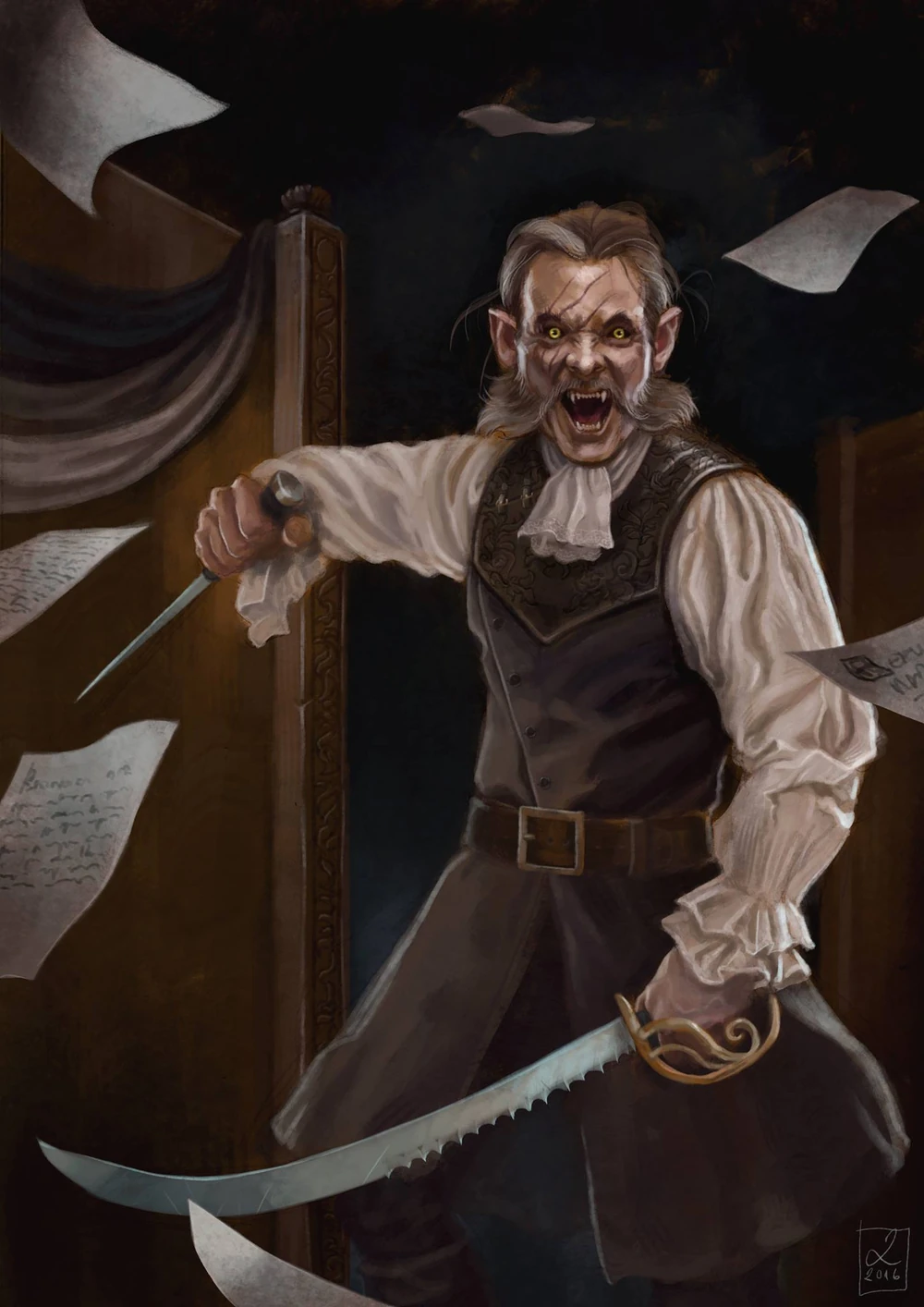
But now, tidings reaching him of those two dark, unavenged butcheries of school-children on the Isle of Alvald,—by Vampire and Werewolf, as men whisper,—the man’s spirit takes fire; he will rouse a people against such horrors. And verily, after certain harangues of his, delivered in Hulona taverns with a ghastly eloquence on Monsters; and yet more when emissaries of the Health Department arrived, wagons laden with vaccine-chests, escorted by soldiery, and bearing a decree that whoso refused inoculation should be set beyond the law,—then did the whole rustic population, prone by long habit to superstition, rise as one; shatter the vaccines—“that murderous device which would render us the daintier prey of Werewolves!”—hew down the Trees of Liberty; and, within ten days, behold, in Hulona’s very heart, an armed Insurrection, wherewith Constitutional Guard and local Republicans can in no wise cope, but flee distracted, leaving the whole District to Fargen’s dominion.
On the Seventh of Hirandial he unfurls a Banner with the Greyhound, proclaims himself King’s Insurgent; and though Ostven had dismissed him with a light word,—“Fargen? A person of no significance!”—(which stroke glanced perhaps more at Austenberg than at Fargen), it soon appears that his significance is of a sterner kind. The shock-troops of his force are those practised, ruthless, well-nigh invisible Hunters of Werewolf and Vampire; men whom the Preamble of the Constitution, by transforming Monsters into Citizens, had bereft of livelihood; men whom a later Decree, punishing “natural crimes” of the old regime, had visited with one uniform penalty—five years’ imprisonment, be the tally of slain what it might[1]. For the most part poor peasants, who had thereby fed their families, they have now served their term; and come forth with a new account to settle against the Republic.
Into the National Assembly, already smitten from without, there darts this fresh wound from within: a Royalist Standard waving free in Guntreland’s very bosom! A wave thereupon runs through all benches,—of patriotism, and likewise of a more personal apprehension; for before King Alphonse all Representatives alike, be they of what faction soever, are but “arch-usurpers.” Hence Hensher’s proposal,—the proclamation of the utmost State of War—slightly amended by a joint commission, and borne along on acclamatory shouts, is at last, by urgency of time, set upon the order of the day.
Freve, of the Committee of Public Command, ascends the tribune; speaks of the Enemy’s might, of the necessity that delay cease. With an eye ecstatic, yet stricken through with fear, he paints the Wheel and the Gallows awaiting the whole Assembly in case of defeat; and is interrupted by cries of “Down with it!”—directed less at the speaker than at Wheel and Gallows themselves. Lest this now inevitable Most Bellicose State be taken for a mere Hensherite device, there follows him the Masdenist Arthur Zold; eyes kindled, brotherly smile cast to all sides, voice inspired,—calling to battle against Tyrants. His accents fall like a breath of encouragement after Freve’s bodeful visions.
“O sacred Freedom!” he cries, “open the eyes of slaves blinded by Tyranny; unite thy people in the strength of Compatriotism; inspire them with fearless valour in the noble enterprise of war in thy name!”—and from all quarters bursts the “Hurrah!” He adds: “Tyrants, tremble before the free People that rises; for it shall not return the sword to its scabbard till it have exacted from you account for all ye have done to unhappy Humanity!” Men who yesterday hissed and cried “Boo!” at each other’s lips now fall into compatriotic embraces.
A Hrebsist, Filusen, proposes that in this Constitutional and Lawful Army—the first truly democratic host on Earth—the soldiers themselves elect their officers, yea their generals: which motion is rejected. Nevertheless, under such generals as we possess, enthusiasm flames high to defend our Freedom. Unite, O great Nation of Guntreland! Tremble, ye Tyrants,—and thou too, arch-traitor Fargen!—for the hour of decisive reckoning draws nigh.
[1] This decree also punished by the seizure of part of the farmland anyone who used serf’s work during the old regime and who enjoyed privileges offensive to the Justice ; part of this farmland was confiscated on behalf of the Republic, and part of it was divided to the former serfs.