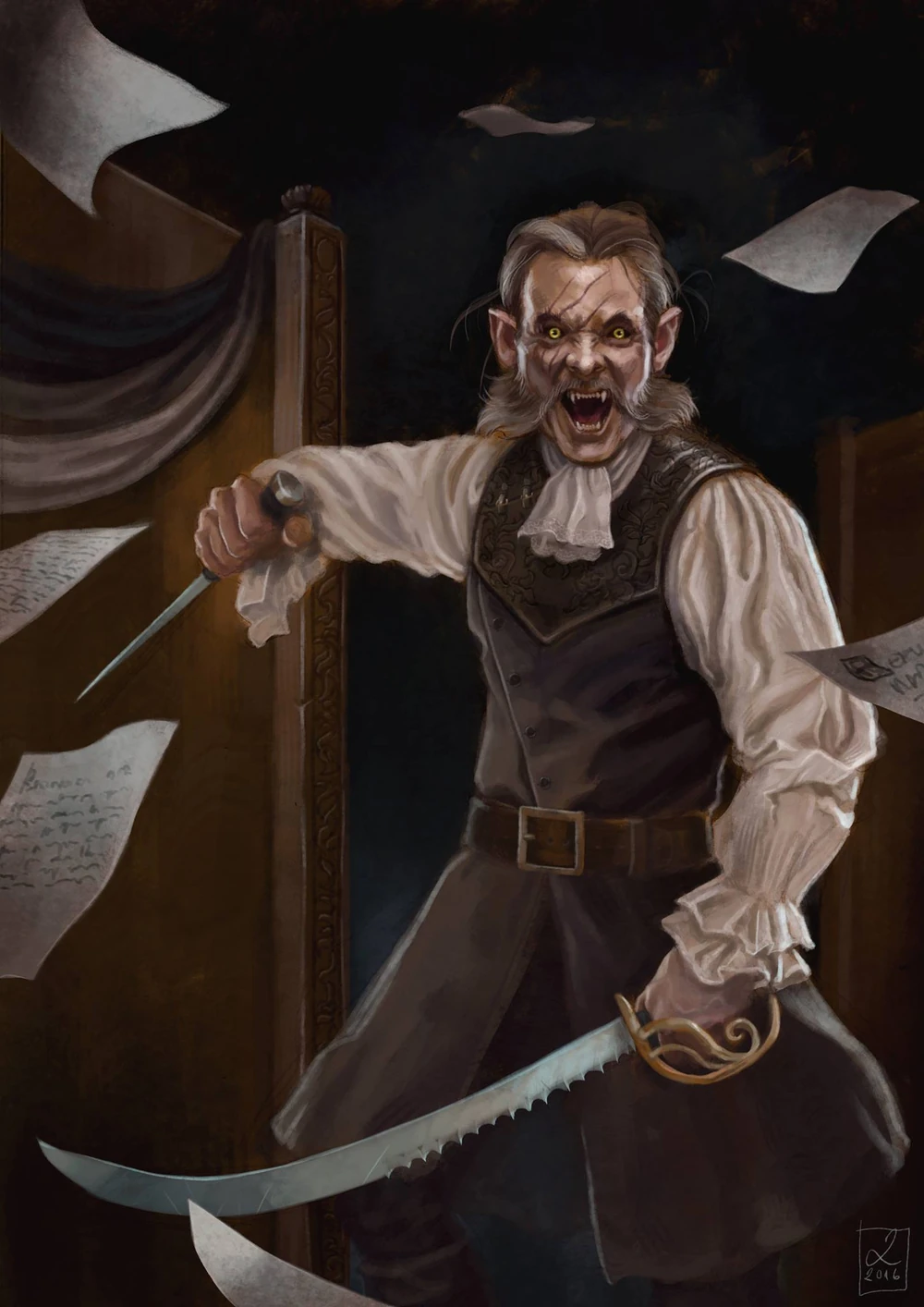

From the Diary of Johan Zol — 17th of Hirandial
(...) At the news of the murder of a National Representative, a clamour and cries of mourning resounded throughout the whole square before the Municipal Intendancy; and upon the faces of my schoolfellows I saw expressions of fear more powerful than I had ever seen there before. This is because many of the pupils, Magpie among them, understand the “inviolability” of National Representatives as some supernatural power, a physical invulnerability possessed by the Representatives of the National Assembly; and the discovery that the Royalists possess such knives as are capable of killing invulnerable human beings has utterly shattered their faith in any meaningful possibility of Republican resistance against so mighty an enemy—an enemy which, according to the tidings reaching us, was gathering an army from all six Continents in order to crush the Revolution.
But the obligations of the Utmost State of War swiftly replaced disbelief at the death of the Representative. The legal educator explained to those who did not know that the inviolability of National Representatives means nothing other than that they cannot be arrested without the consent of the Assembly, and that whoever physically injures a National Representative is punished with annihilation as an enemy of the Republic.
Four tables were set up before the Municipal building, and the Citizens were instructed to form four lines, according to sex and age. At each table sat a Municipal official wearing the cockade, entering the names of the people into the registers, so that the Committee might distribute their assignments with the greatest speed.
Standing in the lines, the people encouraged one another with cries of “Honour the Constitution, Citizens!”, warmly clapping upon the shoulder, or warmly extending a hand, to whoever had just been entered upon the registers.
The heads of the people in the other lines were turned most of all towards that line in which the recruitment for the Army was being carried out. Mothers, wives, and sisters gazed upon their sons, husbands, and brothers, who would, with exceedingly perilous defiance of the blockade, cross over to the Continent and enter the bloody struggle against Royalism. Yet the danger hanging above us all, which made the life of every good Republican itself imperilled, seemed to lessen the distinction between soldier and citizen; indeed, it caused all to feel themselves soldiers standing in the same rank, and the anxiety of the men and women over their family members going to war was thereby softened by the anxiety they now felt for their own lives.
Barschaft proudly displayed his tall and handsome brother, whose red head, owing to his great height, rose above the line of recruits; the brother was turned towards his fiancée, who stood in the line for the occupations assigned to female Citizens.
Yet neither the patriotic enthusiasm of the Utmost State of War, nor the fear of an enemy landing and of Royalist vengeance, nor even the fear of Royalists concealed within our own ranks—whose existence no one doubts, since the Masdenite, the Henscherist, and the Hrebsovian newspapers which reach the island all write of them in one fashion or another—can make the people cease to think of what befell poor Lore and unhappy Baver, whose murderers are still unknown.
The presence of their parents at public activities silently spreads a message of insecurity wherever those parents happen to be; and there arises again the question whether there may not be, after all, a little truth in the “superstition” by which the “masters” once deceived the subjected people.
True, the Utmost State of War has imposed upon us all a whole day of patriotic obligations, leaving little time or opportunity for the people to repeat tales of superstition; and besides, there are the Commissioners of the various Committees, who organise and supervise the labour of the day. But when, this afternoon, Citizen Abrant deliberately dropped a bucket of earth, previously gathered from his cellar, instead of handing it over to Citizen Fulson, the Werewolf, everyone pretended to believe that the thing had happened by accident; and no one—not even Fulson himself—reported this “sabotage of Republican labour” to the Quart Commissioner.
Upon returning to the school building, though only for a short while, for we were told that until further notice our activities would consist exclusively of military education and the fulfilment of the duties of the Utmost State of War, I felt, more strongly than ever before, the distrust which all had begun to feel towards one another.
It is spoken more and more frequently that the parents of certain boys are Royalists; and then that certain boys themselves, in our own class, are Royalists. Men are spoken of who, by night, light and extinguish candles in their houses in order to send secret signals to Royalist ships and balloons; of those who secretly prepare poisons with which they intend to poison all the food and drinking water of Alvald; and of those preparing every other possible treachery by which they might assist the Royalist invasion.
Like a dreadful shadow over the whole island, and even over our school, hangs the threat of the return of the Royalists to power. The educators speak of it as something which must be prevented, even at the price of the lives of every inhabitant of Alvald; and the fear of the return of Tyranny, and of the terrible vengeance which the Royalists have prepared for our whole island, has entered the hearts of most of us.
But there are also those who, at first in whispers and then ever more loudly, say that they would like the Monarchy to return; that they would like to return to their homes and parents, and no longer be obliged to live in fear of Werewolves and Vampires, and that they shall not meet the fate of Lore Abrant and Baver Frenzer.
Citizen Filer said that Alvald is a small island, surrounded on every side by a sea in which enemy ships are to be found, and that the fact that the enemy may at any moment attack us and attempt to subjugate us means that we, too, must at every moment be ready to perceive and destroy every enemy of Freedom.
Teier told me that he had heard Rober promising certain children that, when the Monarchy returned, his father, a man of the king, would protect them, provided they associated with him, Rober. But he begged me not to tell anyone, because he did not wish some terrible thing to happen, on his account, either to Rober, who is nevertheless only a boy, or to his parents—some terrible thing which the educators and the Municipal Administration, in their terror of universal treason and their devotion to the Utmost State of War, might regard as an appropriate measure.
I could in no wise agree with this. I said that I must report what I had learned, because in Republicanism everything is public; and because an unpunished crime becomes an encouragement to the free commission of crime, until morality is so corrupted that the good Citizen shall once more become a slave, as he was in the days of the kings.
I asked him whether he wished it to become the case that who should associate with whom depended upon which one's father would be more powerful should our enemies win the war. And I tried to explain to Teier why the reporting of every violation of the Law is necessary for the survival of the Republic, reminding him that our educator of moral instruction had told us the same thing: he who does not help to discover and punish a crime helps that crime to continue and to be repeated—and, by showing compassion towards the guilty, wounds the victim together with him.
This applies even when one fails to report a crime committed against oneself; for by doing so one not only deprives oneself of the honour of calling upon the Law for aid in protection of one's violated rights, but also encourages the guilty person to repeat the same crime against another.
And in the Decree of the Utmost State of War it was written that every weakness is a crime. I therefore said that this meant that Teier himself was a criminal if he showed mercy towards the enemies of the Republic!
Teier merely shrugged his shoulders at this and said that I should do as I thought best; but that he knew he would never associate with someone because of what his father might or might not be able to do, but only because of what that person himself was; and that if others chose their friends differently, that was their affair.
He said that his parents had taught him thus; that he did not consider himself a criminal on account of it; and that, if he must suffer because he did not wish to report someone, then he was prepared to suffer.
I said that if Rober's father truly could help someone after the return of the king, this might mean that he was even now upon the royal side, and perhaps a spy, or something akin to one; and that whoever failed to report all that he knew of this would thereby himself become an accomplice of the royalists in their dishonourable undertaking!
Teier said that he did not believe Rober's father was really still working for the king, because that would be too dangerous for him, since everyone knew his past and everyone would suspect him first; rather, he thought that Rober had merely been making himself important, wishing to acquire friends.
I said that the Republic ought to make men respect, love, and choose as friends those who deserve such friendship by their Virtues, and never those who promise the aid of their parents in the event that the Republic should perish.
I said that everything suspicious must be reported; for it is better that the Republic should know even what it has no necessity to know, than that it should be deprived of information upon which its survival may depend.
The children who had been forcibly returned to the school from their parents were regarded by everyone with a peculiar suspicion, and the Committee charged with determining which among them had left the school of their own accord and which had been taken against their will questioned them almost at every interval between the activities.
Those found to have abandoned the school of their own will shall be deprived of their civil rights for the whole of their lives, and shall be able to recover them only when they have proved themselves Citizens by performing some deed for the Republic.
The end of the day brought us an aerial attack upon Atrolen: several stacks of hay before the house of Citizen Friling suddenly burst into flame, and then the fire spread and swallowed his whole house. Only then did the peasants succeed in extinguishing the conflagration.
But it is said that Eliza-Constitutional was caught by the fire in a hole in the wall of Friling's house, a place which she found comfortable; I have not yet seen her, but they say that the people, with their buckets, managed to put out the fire around her, although all her hair was burned away.
The legal educator, who teaches us one Republican Law every day, taught us this today:
“If a man becomes incapable of repaying a debt through some accidental misfortune, the State shall discharge his debt. If he becomes insolvent through improper conduct, the inhabitants of the municipality who have permitted corruption to enter among them shall discharge the debt together, upon the basis of the register kept by the public officer.”