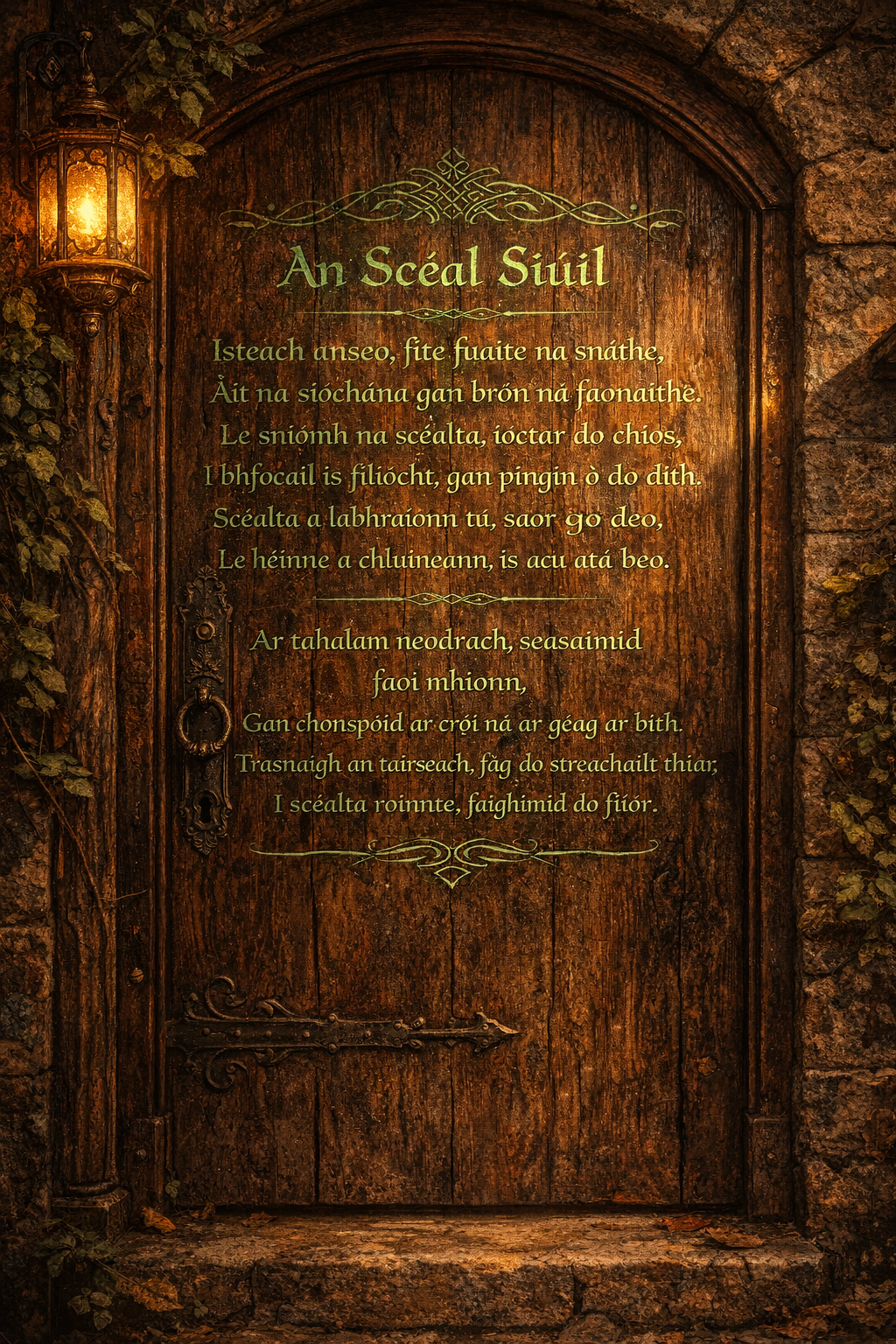

The woman enters with the certainty of someone who has already solved the puzzle.
Jack notices this immediately—the particular set of shoulders that comes from carrying an answer rather than a question. She’s mortal, middle-aged, wearing clothes that suggest academia without shouting it. Her eyes scan the tavern with the quick precision of a researcher cataloging variables.
She walks directly to the bar. No hesitation at the threshold, no moment of adjustment to the wrongness of the space. Either she’s been here before or she’s studied descriptions thoroughly enough to simulate familiarity.
“Jack,” she says. Not a question.
“Welcome.” His smile stretches, warm and wide. “A drink for a tale?”
“I’m not here to trade stories.” She sets a leather satchel on the bar, heavy with documents. “I’m here because you preserve them.
Ah.
Jack’s smile doesn’t falter, but something behind it goes quiet. He reaches for a glass, begins polishing it—an old habit, older than the tavern itself.
“I do preserve them,” he agrees. “Everything spoken at my bar, in my walls. The Contract on my door—”
“‘Stories you speak, free forever, to anyone who hears.’” She quotes it without looking at notes. “I’ve read your threshold twelve times. I’ve traced the etymology of every word. I understand what you offer.”
“Then you understand more than most who enter.”
“I understand enough.” She opens the satchel, pulls out a bound manuscript thick with annotations. “Anna Dalca. Sheolite polymath. Student of four Realms’ methodologies. The only scholar who successfully integrated alchemical animation with Celestial miracle-work, Arcadian contract theory, and Forge design principles.”
Jack sets down the glass.
“She was here,” the woman continues. “Multiple sources confirm it. Gwydion mentioned her visits in a lecture at the Alexandrine archive. Sub-Unit 72’s records reference ‘stories exchanged with A. Dalca, J. Tavern, various dates.’ Zaquiel—” She hesitates here, something crossing her face. “Zaquiel won’t speak of her at all. But he didn’t deny she came here.”
“She did come here,” Jack says softly. “Many times.”
“Then you have her stories. Her tales. Conversations she had, things she discussed, knowledge she shared while sitting at this bar.” The woman’s voice is steady, controlled, but underneath it Jack can hear the tremor of someone who has bet everything on a single answer. “Her methodology. Her integration framework. The principles she developed before Sheol fell.”
Jack is quiet for a long moment.
The hearth crackles. Somewhere in the back, Elsie moves between tables, blue skin catching the firelight. A pair of Ruskenn cytes murmur to each other in the corner, one voice finishing what the other started.
“What’s your name?” Jack asks.
“Lena. Lena Osei.” She blinks at the question, recalibrating. “I’m a researcher. Comparative ontological systems. I’ve spent nine years trying to reconstruct Dalca’s work from fragments—student notes, secondary sources, implications in her contemporaries’ writings. I’ve gotten close. But there are gaps. Critical gaps that I can’t bridge because the primary source is—”
“Gone.”
“Gone.” The word costs her something to say. “Along with everything she knew that she hadn’t yet published. Hadn’t yet taught. Hadn’t yet—” She stops. Breathes. “You preserve stories. She told stories here. Therefore you have information that no longer exists anywhere else in the cosmos. It’s basic deduction.”
“It is,” Jack agrees. “And you’re not wrong.”
Lena’s eyes brighten. “Then—”
“I have stories she told. I have her laughter, her complaints, her voice describing what it felt like when an experiment failed spectacularly. I have her opinions on Forge aesthetics. I have an argument she had with Gwydion about proper citation methodology. I have her telling me, one evening, about the first time she saw alchemical fire move when no one was looking—how it danced, she said, like it was happy to be unobserved.”
Jack’s voice is gentle. The voice of someone delivering news he has delivered before.
“I don’t have her methodology.”
-----
The silence stretches.
Lena’s face doesn’t crumble—she’s too controlled for that—but Jack watches the hope drain from it, replaced by something colder. The expression of someone rebuilding walls that had briefly come down.
“That’s not possible.” Her voice is flat. “She was a scholar. She discussed her work. Even informally, even in passing, she must have—”
“She came here to rest.” Jack picks up the glass again, resumes polishing. “To be a person instead of a researcher for an evening. To tell stories rather than deliver lectures. She talked about her work the way anyone talks about their day—the frustrations, the breakthroughs, the colleague who wouldn’t listen. Anecdotes. Experiences. The shape of her research, not the substance.”
“But within those anecdotes—fragments, implications—”
“Fragments that don’t cohere. Implications that point in twelve directions. I could tell you that she once mentioned ‘the three conditions for stable cross-Realm animation,’ but I couldn’t tell you what those conditions were. She assumed whoever she was talking to already knew. She was sharing a feeling, not teaching a principle.”
Lena’s hands are flat on the bar, pressing down as if anchoring herself.
“There has to be something. Some way to—” She stops. Starts again. “Her integration framework. The thing that made her work work. The synthesis that let her combine four ontologies into a coherent system. You must have something.”
“The integration was in her head,” Jack says quietly. “Not in any external record. Her students learned pieces—the parts she could teach, the components she could articulate. But the synthesis? The thing that made Anna Dalca Anna Dalca rather than four separate specialists? That wasn’t teachable. Or if it was, she didn’t have time to teach it.”
“Because Sheol fell.”
“Because Sheol fell.”
Lena closes her eyes. Her fingers curl on the bar, then release, then curl again.
“I’ve spent nine years,” she says, and her voice is very quiet now. “Nine years reconstructing her work from the edges inward. Building scaffolding where the architecture used to be. I thought—if I could just find the center, the core principle that held it all together—I could complete what she started. I could—”
She doesn’t finish.
Jack waits.
“Too many people remember her,” Lena says finally, opening her eyes. “Everyone I talk to has a story about Anna Dalca. How brilliant she was. How her mind worked in ways no one else’s did. How she saw connections that weren’t supposed to exist.” A bitter edge enters her voice. “But no one understood her work. Not fully. Not even her students. They have pieces. Partial impressions. Fragments of a whole that died with her.”
“No,” Jack agrees. “They don’t.”
-----
The fire crackles. Elsie passes behind them, glances at Lena’s face, keeps moving.
“I have stories about her,” Jack says, after a while. “If you want them. Her laugh—she had a good laugh, the kind that made other people want to laugh too. The time she tried to explain Forge principles to a Voracian and ended up in a three-hour argument about whether ‘intent’ could be consumed. Her opinion on Gwydion’s metalwork, which was that he was technically flawless and aesthetically cowardly.”
He sets down the glass.
“I can tell you what she was like. I can’t tell you what she knew.”
Lena is quiet for a long time.
“Does this happen often?” she asks. “People coming here, thinking they’ve solved it?”
“More often than I’d like.” Jack’s smile flickers, something raw beneath it. “Clever people. Brilliant people. They trace the logic the same way you did—Jack’s preserves stories, Anna told stories, therefore Jack’s has Anna. The reasoning is airtight.”
“But the conclusion is wrong.”
“The conclusion assumes my tavern is a library. An archive. A place where knowledge is preserved in usable form.” Jack shakes his head. “It’s not. It’s a hearth. A place where people come to rest, to share, to be heard. The Contract preserves what’s spoken—but what’s spoken over drinks is different from what’s written in manuscripts. It’s personal, not systematic. Experiential, not methodological.”
“So she rested here. And because she rested instead of lectured, everything she knew that mattered is gone.”
“Not everything. Her students carry pieces. Her writings survive, some of them. Her influence persists in systems she helped design.”
“Fragments.” Lena’s voice is hollow. “I have fragments. I came here looking for the whole.”
“I know.” Jack’s voice is very gentle. “I’m sorry.”
-----
Lena stands. Gathers her satchel. The manuscript slides back inside, all those annotations suddenly useless.
At the threshold, she pauses.
“The stories,” she says without turning around. “The ones you have. Her laugh, the arguments, the time with the Voracian.”
“Yes?”
“Someday. Not tonight. But someday I might—” She stops. “Would you tell them to me? Even though they won’t help?”
Jack’s smile softens into something true.
“My door is open to anyone with a tale to tell,” he says. “And a tale doesn’t have to be your own. Come back when you’re ready to hear about her. I’ll pour you a drink and tell you what she was like.”
“What she was like,” Lena repeats. “Not what she knew.”
“That’s all I have. It’s what I have of everyone who’s ever rested here. The person, not the expertise. The life, not the work.” Jack pauses. “For most people, that’s enough. For Anna, it will never be enough. I know that. I’ve known it since Sheol fell.”
Lena nods once, tight and controlled.
“Someday,” she says again.
She steps through the door into Dublin’s grey morning light.
-----
Jack stands alone behind the bar, polishing a glass he doesn’t need to polish.
The tavern is quiet. The fire burns low. Somewhere in his walls, preserved in Nexus brass, Anna Dalca laughs at a joke Gwydion told her four centuries ago.
It is not her methodology. It is not her synthesis. It is not the principles that could have changed the cosmos if she’d had time to teach them.
It is her. Just her. The part that could rest.
Jack sets down the glass.
He has hosted this grief many times. He will host it many more. Clever people with airtight reasoning, arriving certain and leaving emptied. He cannot change what his tavern is. He cannot change what the Contract preserves. He can only keep telling them, sadly, that the loophole they found is not a loophole.
The fire crackles.
The lantern burns.
And somewhere in the walls, Anna Dalca’s laugh echoes, preserved forever, helping no one.
-----
Lena Osei returned to Jack’s Tavern seventeen times over the following years. She never asked about Anna’s methodology again. She listened to the stories—the laugh, the arguments, the three-hour debate with the Voracian—and she drank Jack’s mead, and sometimes she cried quietly while the hearth crackled beside her.
She never completed the reconstruction. The center held its secrets. The synthesis died with the scholar who created it.
But she remembered Anna. Not the work—the person. And that, as Jack had promised, was all he had to give.