



Falst in Dungeons & Dragons 5e

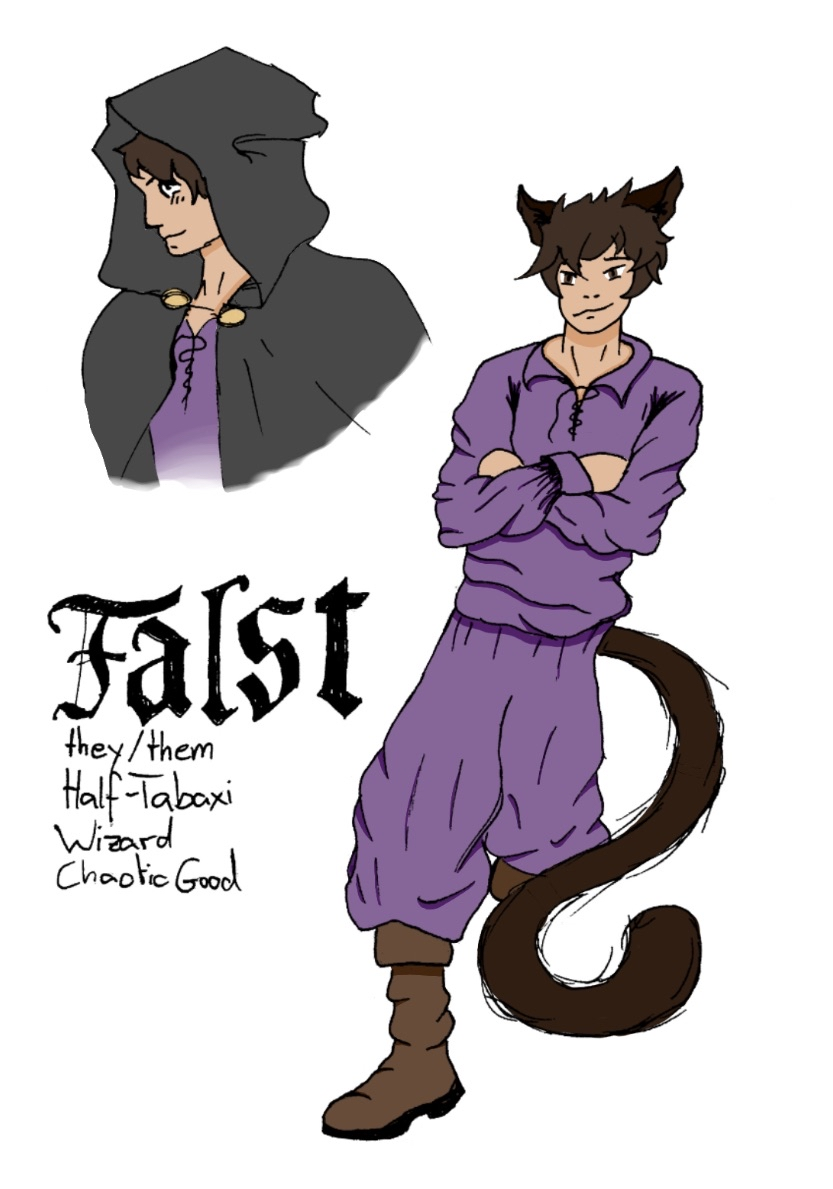
Falst
3 Level (0/2700 XP for level-up) Wayfarer Background Half-Tabaxi Race / Species / Heritage CG AlignmentLevel 3
Hit Dice: 3/3
1d6+2 Class 1
Hit Points
Initiative (DEX)
Armor Class (AC)
Prof. Bonus
Speed (walk/run/fly)
Passive Perception
Lucky
Arcane Recovery
| +4 | Expertise Bonus | |
| +2 | Proficiency Bonus |
| -1 | Strength | |
| +2 | Dexterity | |
| +2 | Constitution | |
| +5 | Intelligence | |
| +3 | Wisdom | |
| +0 | Charisma |
| +2 | Acrobatics | DEX | |
| +1 | Animal Handling | WIS | |
| +5 | Arcana | INT | |
| -1 | Athletics | STR | |
| +0 | Deception | CHA | |
| +7 | History | INT | |
| +1 | Insight | WIS | |
| +0 | Intimidation | CHA | |
| +3 | Investigation | INT |
| +1 | Medicine | WIS | |
| +3 | Nature | INT | |
| +1 | Perception | WIS | |
| +0 | Performance | CHA | |
| +0 | Persuasion | CHA | |
| +5 | Religion | INT | |
| +2 | Sleight of Hand | DEX | |
| +2 | Stealth | DEX | |
| +1 | Survival | WIS |
| Weapon / Attack | AB | Abi | Dmg | Dmg Type | |
|---|---|---|---|---|---|
| Quarterstaff | +1 | STR | 1d6or1d8-1 | bludgeoning | |
| Versatile | |||||
Spell Book
Quarterstaff -> think gandalf staff, crystal in top part embedded, gnarly wood
Component Pouch
Explorer's Pack
Spellbook: small, leatherbound, tied shut with leather rope.
Equipment Copper: 0, Silver: 0, Electrum: 0, Gold: 345, Platinum: 0 Money
Common
Draconic
Ancient Draconic
Simple Weapons
Calligrapher's Supplies: Utilize: Write text with impressive flourishes that guard against forgery (DC 15 D20+Prof.) Craft: Ink, Spell Scroll
Languages & Proficiencies
MAGE ARMOR: AC 15
Notes
Race (source)
™ & © Wizards of the Coast - D & D 5e Character Sheet v2.10, made by Tillerz - Updated: 2026-05-13
To print this sheet: Expand the spell book (if you have any entries there), then click "Print Sheet" at the top, select "Print to PDF" and format A3. Then print the resulting PDF to whichever format you need with "fit to page" selected.
The statblocks of your Weapons, armor and other important/magical equipment
The statblocks of your class features
SRD, TCoE
Wizard (Order of Scribes)
You start with the following equipment, in addition to the equipment granted by your background:
- (a) a quarterstaff or (b) a dagger
- (a) a component pouch or (b) an arcane focus
- (a) a scholar's pack or (b) an explorer's pack
- A spellbook
As a student of arcane magic, you have a spellbook containing spells that show the first glimmerings of your true power.
Cantrips
At 1st level, you know three cantrips of your choice from the wizard spell list. You learn additional wizard cantrips of your choice at higher levels, as shown in the Cantrips Known column of the Wizard table.Spellbook
At 1st level, you have a spellbook containing six 1st-level wizard spells of your choice. Your spellbook is the repository of the wizard spells you know, except your cantrips, which are fixed in your mind. The spells that you add to your spellbook as you gain levels reflect the arcane research you conduct on your own, as well as intellectual breakthroughs you have had about the nature of the multiverse. You might find other spells during your adventures. You could discover a spell recorded on a scroll in an evil wizard's chest, for example, or in a dusty tome in an ancient library. Copying a Spell into the Book. When you find a wizard spell of 1st level or higher, you can add it to your spellbook if it is of a spell level you can prepare and if you can spare the time to decipher and copy it. Copying a spell into your spellbook involves reproducing the basic form of the spell, then deciphering the unique system of notation used by the wizard who wrote it. You must practice the spell until you understand the sounds or gestures required, then transcribe it into your spellbook using your own notation. For each level of the spell, the process takes 2 hours and costs 50 gp. The cost represents material components you expend as you experiment with the spell to master it, as well as the fine inks you need to record it. Once you have spent this time and money, you can prepare the spell just like your other spells. Replacing the Book. You can copy a spell from your own spellbook into another book-for example, if you want to make a backup copy of your spellbook. This is just like copying a new spell into your spellbook, but faster and easier, since you understand your own notation and already know how to cast the spell. You need spend only 1 hour and 10 gp for each level of the copied spell. If you lose your spellbook, you can use the same procedure to transcribe the spells that you have prepared into a new spellbook. Filling out the remainder of your spellbook requires you to find new spells to do so, as normal. For this reason, many wizards keep backup spellbooks in a safe place. The Book's Appearance. Your spellbook is a unique compilation of spells, with its own decorative flourishes and margin notes. It might be a plain, functional leather volume that you received as a gift from your master, a finely bound gilt-edged tome you found in an ancient library or even a loose collection of notes scrounged together after you lost your previous spellbook in a mishap.Preparing and Casting Spells
The Wizard table shows how many spell slots you have to cast your wizard spells of 1st level and higher. To cast one of these spells, you must expend a slot of the spell's level or higher. You regain all expended spell slots when you finish a long rest. You prepare the list of wizard spells that are available for you to cast. To do so, choose a number of wizard spells from your spellbook equal to your Intelligence modifier + your wizard level (minimum of one spell). The spells must be of a level for which you have spell slots. For example, if you're a 3rd-level wizard, you have four 1st-level and two 2nd-level spell slots. With an Intelligence of 16, your list of prepared spells can include six spells of 1st or 2nd level, in any combination, chosen from your spellbook. If you prepare the 1st-level spell magic missile, you can cast it using a 1st-level or a 2nd-level slot. Casting the spell doesn't remove it from your list of prepared spells. You can change your list of prepared spells when you finish a long rest. Preparing a new list of wizard spells requires time spent studying your spellbook and memorizing the incantations and gestures you must make to cast the spell: at least 1 minute per spell level for each spell on your list.Spellcasting Ability
Intelligence is your spellcasting ability for your wizard spells, since you learn your spells through dedicated study and memorization. You use your Intelligence whenever a spell refers to your spellcasting ability. In addition, you use your Intelligence modifier when setting the saving throw DC for a wizard spell you cast and when making an attack roll with one. Spell save DC = 8 + your proficiency bonus + your Intelligence modifier Spell attack modifier = your proficiency bonus + your Intelligence modifierRitual Casting
You can cast a wizard spell as a ritual if that spell has the ritual tag and you have the spell in your spellbook. You don't need to have the spell prepared.Spellcasting Focus
You can use an arcane focus as a spellcasting focus for your wizard spells.Learning Spells of 1st Level and Higher
Each time you gain a wizard level, you can add two wizard spells of your choice to your spellbook. Each of these spells must be of a level for which you have spell slots, as shown on the Wizard table. On your adventures, you might find other spells that you can add to your spellbook.Arcane Recovery
You have learned to regain some of your magical energy by studying your spellbook. Once per day when you finish a short rest, you can choose expended spell slots to recover. The spell slots can have a combined level that is equal to or less than half your wizard level (rounded up), and none of the slots can be 6th level or higher. For example, if you're a 4th-level wizard, you can recover up to two levels worth of spell slots. You can recover either a 2nd-level spell slot or two 1st-level spell slots.Arcane Tradition - Order of Scribes
When you reach 2nd level, you choose an arcane tradition, shaping your practice of magic through one of the following schools. Your choice grants you features at 2nd level and again at 6th, 10th, and 14th level.Wizardly Quill
At 2nd level, as a bonus action, you can magically create a Tiny quill in your free hand. The magic quill has the following properties:- The quill doesn't require ink. When you write with it, it produces ink in a color of your choice on the writing surface.
- The time you must spend to copy a spell into your spell book equals 2 minutes per spell level if you use the quill for the transcription.
- You can erase anything you write with the quill if you wave the feather over the text as a bonus action, provided the text is within 5 feet of you.
Awakened Spellbook
Using specially prepared inks and ancient incantations passed down by your wizardly order, you have awakened an arcane sentience within your spellbook. At 2nd level, while you are holding the book, it grants you the following benefits:- You can use the book as a spellcasting focus for your wizard spells.
- When you cast a wizard spell with a spell slot, you can temporarily replace its damage type with a type that appears in another spell in your spellbook, which magically alters the spell's formula for this casting only. The latter spell must be of the same level as the spell slot you expend.
- When you cast a wizard spell as a ritual, you can use the spell's normal casting time, rather than adding 10 minutes to it. Once you use this benefit, you can't do so again until you finish a long rest.
Cantrip Formulas (Optional)
At 3rd level, you have scribed a set of arcane formulas in your spellbook that you can use to formulate a cantrip in your mind. Whenever you finish a long rest and consult those formulas in your spellbook, you can replace one wizard cantrip you know with another cantrip from the wizard spell list.Ability Score Improvement
When you reach 4th level, and again at 8th, 12th, 16th, and 19th level, you can increase one ability score of your choice by 2, or you can increase two ability scores of your choice by 1. As normal, you can't increase an ability score above 20 using this feature.Manifest Mind
At 6th level, you can conjure forth the mind of your Awakened Spellbook. As a bonus action while the book is on your person, you can cause the mind to manifest as a Tiny spectral object, hovering in an unoccupied space of your choice within 60 feet of you. The spectral mind is intangible and doesn't occupy its space, and it sheds dim light in a 10-foot radius. It looks like a ghostly tome, a cascade of text, or a scholar from the past (your choice). While manifested, the spectral mind can hear and see, and it has darkvision with a range of 60 feet. The mind can telepathically share with you what it sees and hears (no action required). Whenever you cast a wizard spell on your turn, you can cast it as if you were in the spectral mind's space, instead of your own, using its senses. You can do so a number of times per day equal to your proficiency bonus, and you regain all expended uses when you finish a long rest. As a bonus action, you can cause the spectral mind to hover up to 30 feet to an unoccupied space that you or it can see. It can pass through creatures but not objects. The spectral mind stops manifesting if it is ever more than 300 feet away from you, if someone casts Dispel Magic on it, if the Awakened Spellbook is destroyed, if you die, or if you dismiss the spectral mind as a bonus action. Once you conjure the mind, you can't do so again until you finish a long rest, unless you expend a spell slot of any level to conjure it again.Master Scriviner
At 10th level, whenever you finish a long rest, you can create one magic scroll by touching your Wizardly Quill to a blank piece of paper or parchment and causing one spell from your Awakened Spellbook to be copied onto the scroll. The spellbook must be within 5 feet of you when you make the scroll. The chosen spell must be of 1st or 2nd level and must have a casting time of 1 action. Once in the scroll, the spell's power is enhanced, counting as one level higher than normal. You can cast the spell from the scroll by reading it as an action. The scroll is unintelligible to anyone else, and the spell vanishes from the scroll when you cast it or when you finish your next long rest. You are also adept at crafting spell scrolls, which are described in the treasure chapter of the Dungeon Master's Guide. The gold and time you must spend to make such a scroll are halved if you use your Wizardly Quill.One with the Word
At 14th level, your connection to your Awakened Spellbook has become so profound that your soul has become entwined with it. While the book is on your person, you have advantage on all Intelligence (Arcana) checks, as the spellbook helps you remember magical lore. Moreover, if you take damage while your spellbook's mind is manifested, you can prevent all of that damage to you by using your reaction to dismiss the spectral mind, using its magic to save yourself. Then roll 3d6. The spellbook temporarily loses spells of your choice that have a combined spell level equal to that roll or higher. For example, if the roll's total is 9, spells vanish from the book that have a combined level of at least 9, which could mean one 9th-level spell, three 3rd-level spells, or some other combination. If there aren't enough spells in the book to cover this cost, you drop to 0 hit points. Until you finish 1d6 long rests, you are incapable of casting the lost spells, even if you find them on a scroll or in another spellbook. After you finish the required number of rests, the spells reappear in the spell book. Once you use this reaction, you can't do so again until you finish a long rest.Spell Mastery
At 18th level, you have achieved such mastery over certain spells that you can cast them at will. Choose a 1st-level wizard spell and a 2nd-level wizard spell that are in your spellbook. You can cast those spells at their lowest level without expending a spell slot when you have them prepared. If you want to cast either spell at a higher level, you must expend a spell slot as normal. By spending 8 hours in study, you can exchange one or both of the spells you chose for different spells of the same levels.Signature Spells
When you reach 20th level, you gain mastery over two powerful spells and can cast them with little effort. Choose two 3rd-level wizard spells in your spellbook as your signature spells. You always have these spells prepared, they don't count against the number of spells you have prepared, and you can cast each of them once at 3rd level without expending a spell slot. When you do so, you can't do so again until you finish a short or long rest. If you want to cast either spell at a higher level, you must expend a spell slot as normal.| Level | Proficiency | Features | Cantrips | --- Spell Slots Per Spell Level --- | ||||||||||
|---|---|---|---|---|---|---|---|---|---|---|---|---|---|---|
| ^ | Bonus ^ | ^ | Known ^ | 1st | 2nd | 3rd | 4th | 5th | 6th | 7th | 8th | 9th | ||
| :-----: | :-----------: | :------------- | :--------: | :--: | :--: | :--: | :--: | :--: | :--: | :--: | :--: | :--: | ||
| 1st | +2 | Spellcasting, Arcane Recovery | 3 | 2 | — | — | — | — | — | — | — | — | ||
| 2nd | +2 | Arcane Tradition | 3 | 3 | — | — | — | — | — | — | — | — | ||
| 3rd | +2 | Cantrip Formulas (Optional) | 3 | 4 | 2 | — | — | — | — | — | — | — | ||
| 4th | +2 | Ability Score Improvement | 4 | 4 | 3 | — | — | — | — | — | — | — | ||
| 5th | +3 | — | 4 | 4 | 3 | 2 | — | — | — | — | — | — | ||
| 6th | +3 | Arcane Tradition feature | 4 | 4 | 3 | 3 | — | — | — | — | — | — | ||
| 7th | +3 | — | 4 | 4 | 3 | 3 | 1 | — | — | — | — | — | ||
| 8th | +3 | Ability Score Improvement | 4 | 4 | 3 | 3 | 2 | — | — | — | — | — | ||
| 9th | +4 | — | 4 | 4 | 3 | 3 | 2 | 1 | — | — | — | — | ||
| 10th | +4 | Arcane Tradition feature | 5 | 4 | 3 | 3 | 2 | 2 | — | — | — | — | ||
| 11th | +4 | — | 5 | 4 | 3 | 3 | 2 | 2 | 1 | — | — | — | ||
| 12th | +4 | Ability Score Improvement | 5 | 4 | 3 | 3 | 2 | 2 | 1 | — | — | — | ||
| 13th | +5 | — | 5 | 4 | 3 | 3 | 2 | 2 | 1 | 1 | — | — | ||
| 14th | +5 | Arcane Tradition feature | 5 | 4 | 3 | 3 | 2 | 2 | 1 | 1 | — | — | ||
| 15th | +5 | — | 5 | 4 | 3 | 3 | 2 | 2 | 1 | 1 | 1 | — | ||
| 16th | +5 | Ability Score Improvement | 5 | 4 | 3 | 3 | 2 | 2 | 1 | 1 | 1 | — | ||
| 17th | +6 | — | 5 | 4 | 3 | 3 | 2 | 3 | 1 | 1 | 1 | 1 | ||
| 18th | +6 | Spell Mastery | 5 | 4 | 3 | 3 | 3 | 3 | 1 | 1 | 1 | 1 | ||
| 19th | +6 | Ability Score Improvement | 5 | 4 | 3 | 3 | 3 | 3 | 2 | 1 | 1 | 1 | ||
| 20th | +6 | Signature Spells | 5 | 4 | 3 | 3 | 3 | 3 | 2 | 2 | 1 | 1 |
Statblocks for your familiars, mounts etc.
Statblocks for race/species of the character.
Statblocks for companions, followers and other allies.
Statblocks for your spells.
Level 0 Spells
Player's Handbook pg 267
Elementalism
0-level (Cantrip) Transmutation
Player's Handbook
Fire Bolt
0-level (Cantrip) Evocation
You hurl a mote of fire at a creature or object within range. Make a ranged spell attack against the target. On a hit, the target takes 1d10 fire damage. A flammable object hit by this spell ignites if it isn't being worn or carried.
This spell's damage increases by 1d10 when you reach 5th level (2d10), 11th level (3d10), and 17th level (4d10).
Player's Handbook
Mage Hand
0-level (Cantrip) Conjuration
A spectral, floating hand appears at a point you choose within range. The hand lasts for the duration or until you dismiss it as an action. The hand vanishes if it is ever more than 30 feet away from you or if you cast this spell again.
You can use your action to control the hand. You can use the hand to manipulate an object, open an unlocked door or container, stow or retrieve an item from an open container, or pour the contents out of a vial. You can move the hand up to 30 feet each time you use it.
The hand can't attack, activate magic items, or carry more than 10 pounds.
Player's Handbook
Minor Illusion
0-level (Cantrip) Illusion
You create a sound or an image of an object within range that lasts for the duration. The illusion also ends if you dismiss it as an action or cast this spell again.
If you create a sound, its volume can range from a whisper to a scream. It can be your voice, someone else's voice, a lion's roar, a beating of drums, or any other sound you choose. The sound continues unabated throughout the duration, or you can make discrete sounds at different times before the spell ends.
If you create an image of an object - such as a chair, muddy footprints, or a small chest - it must be no larger than a 5-foot cube. The image can't create sound, light, smell, or any other sensory effect. Physical interaction with the image reveals it to be an illusion, because things can pass through it.
If a creature uses its action to examine the sound or image, the creature can determine that it is an illusion with a successful Intelligence (Investigation) check against your spell save DC. If a creature discerns the illusion for what it is, the illusion becomes faint to the creature.
Level 1 Spells
Player's Handbook
Burning Hands
1-level Evocation
As you hold your hands with thumbs touching and fingers spread, a thin sheet of flames shoots forth from your outstretched fingertips. Each creature in a 15-foot cone must make a Dexterity saving throw. A creature takes 3d6 fire damage on a failed save, or half as much damage on a successful one.
The fire ignites any flammable objects in the area that aren't being worn or carried.
When you cast this spell using a spell slot of 2nd level or higher, the damage increases by 1d6 for each slot level above 1st.
Player's Handbook
Chromatic Orb
1-level Evocation
You hurl a 4-inch-diameter sphere of energy at a creature that you can see within range. You choose acid, cold, fire, lightning, poison, or thunder for the type of orb you create, and then make a ranged spell attack against the target. If the attack hits, the creature takes 3d8 damage of the type you chose.
When you cast this spell using a spell slot of 2nd level or higher, the damage increases by 1d8 for each slot level above 1st.
Player's Handbook
Mage Armor
1-level Abjuration
You touch a willing creature who isn't wearing armor, and a protective magical force surrounds it until the spell ends. The target's base AC becomes 13 + its Dexterity modifier. The spell ends if the target dons armor or if you dismiss the spell as an action.
PHB'24 p.295
Magic Missile
1-level Evocation
Strixhaven: A Curriculum of Chaos
Silvery Barbs
1-level Enchantment
You magically distract the triggering creature and turn its momentary uncertainty into encouragement for another creature. The triggering creature must reroll the d20 and use the lower roll.
You can then choose a different creature you can see within range (you can choose yourself). The chosen creature has advantage on the next attack roll, ability check, or saving throw it makes within 1 minute. A creature can be empowered by only one use of this spell at a time.
Player's Handbook
Sleep
1-level Enchantment
This spell sends creatures into a magical slumber. Roll 5d8; the total is how many hit points of creatures this spell can affect. Creatures within 20 feet of a point you choose within range are affected in ascending order of their current hit points (ignoring unconscious creatures).
Starting with the creature that has the lowest current hit points, each creature affected by this spell falls unconscious until the spell ends, the sleeper takes damage, or someone uses an action to shake or slap the sleeper awake. Subtract each creature's hit points from the total before moving on to the creature with the next lowest hit points. A creature's hit points must be equal to or less than the remaining total for that creature to be affected.
Undead and creatures immune to being charmed aren't affected by this spell.
When you cast this spell using a spell slot of 2nd level or higher, roll an additional 2d8 for each slot level above 1st.
Player's Handbook
Detect Magic
1-level Divination
Ritual - does not require spell slot, takes 10 minutes longerFor the duration, you sense the presence of magic within 30 feet of you. If you sense magic in this way, you can use your action to see a faint aura around any visible creature or object in the area that bears magic, and you learn its school of magic, if any.
The spell can penetrate most barriers, but it is blocked by 1 foot of stone, 1 inch of common metal, a thin sheet of lead, or 3 feet of wood or dirt.
Player's Handbook
Find Familiar
1-level Conjuration
You gain the service of a familiar, a spirit that takes an animal form you choose, and uses the stat block of one of the following: bat, cat, crab, frog, hawk, lizard, octopus, owl, snake, fish, rat, raven, sea horse, spider, or weasel. Appearing in an unoccupied space within range, the familiar has the statistics of the chosen form, though it is a celestial, fey, or fiend (your choice) instead of a beast.
Your familiar acts independently of you, but it always obeys your commands. In combat, it rolls its own initiative and acts on its own turn. A familiar can't attack, but it can take other actions as normal.
When the familiar drops to 0 hit points, it disappears, leaving behind no physical form. It reappears after you cast this spell again. As an action, you can temporarily dismiss the familiar to a pocket dimension. Alternatively, you can dismiss it forever. As an action while it is temporarily dismissed, you can cause it to reappear in any unoccupied space within 30 feet of you. Whenever the familiar drops to 0 hit points or disappears into the pocket dimension, it leaves behind in its space anything it was wearing or carrying.
While your familiar is within 100 feet of you, you can communicate with it telepathically. Additionally, as an action, you can see through your familiar's eyes and hear what it hears until the start of your next turn, gaining the benefits of any special senses that the familiar has. During this time, you are deaf and blind with regard to your own senses.
You can't have more than one familiar at a time. If you cast this spell while you already have a familiar, you instead cause it to adopt a new form. Choose one of the forms from the above list. Your familiar transforms into the chosen creature.
Finally, when you cast a spell with a range of touch, your familiar can deliver the spell as if it had cast the spell. Your familiar must be within 100 feet of you, and it must use its reaction to deliver the spell when you cast it. If the spell requires an attack roll, you use your attack modifier for the roll.
Level 2 Spells
Basic Rules (2014) - Modified
Shatter
2-level Evocation
A sudden loud ringing noise, painfully intense, erupts from a point of your choice within range. Each creature in a 10-foot-radius sphere centered on that point must make a Constitution saving throw. A creature takes 3d8 thunder damage on a failed save, or half as much damage on a successful one. Constructs have disadvantage on this saving throw.
A nonmagical object that isn't being worn or carried also takes the damage if it's in the spell's area.
When you cast this spell using a spell slot of 3rd level or higher, the damage increases by 1d8 for each slot level above 2nd.
Basic Rules (2014)
Misty Step
2-level Conjuration
Briefly surrounded by silvery mist, you teleport up to 30 feet to an unoccupied space that you can see.
Statblocks for your Trinkets, businesses, building, castles, empires.
World Anvil: The Ultimate Worldbuilding Toolset & RPG Campaign Manager
Created for Dungeon Masters and Game Masters, World Anvil has everything you need to build your own homebrew RPG campaign setting, and run your games, either online or around the table!
- Speed up prep with a whole library of community statblocks you can copy (and edit!)
- Enthrall your players with interactive maps, timelines, and a whole wiki of your world
- Keep track of NPCs, PC character sheets, monster stats, treasure, journals, notes and more
- Quickly look up essential info with session notes, campaign map markers, and bookmarked lore at your fingertips
- Build your own campaign setting, or expand a prewritten campaign, with expertly created worldbuilding templates and prompts
- Control who sees what in your worldbuilding wiki with secrets and subscriber groups
- Collaborate with players and GMs to build the campaign setting of your dreams
- NEVER lose your notes!
GET STARTED TODAY!
Take the first step. Create your account. Your world and characters await!
100+ RPG systems


Find your way!
Resources
WHO WE ARE
LEGAL
Listen to our Podcast